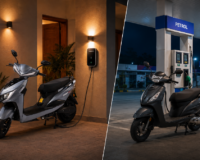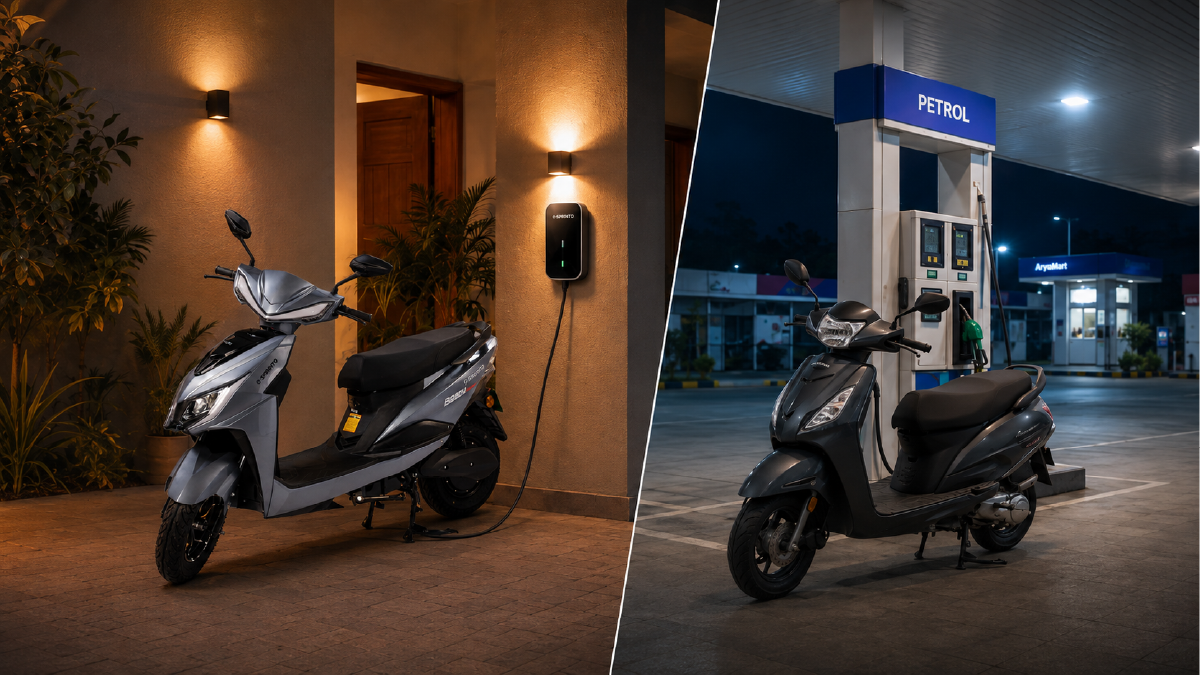
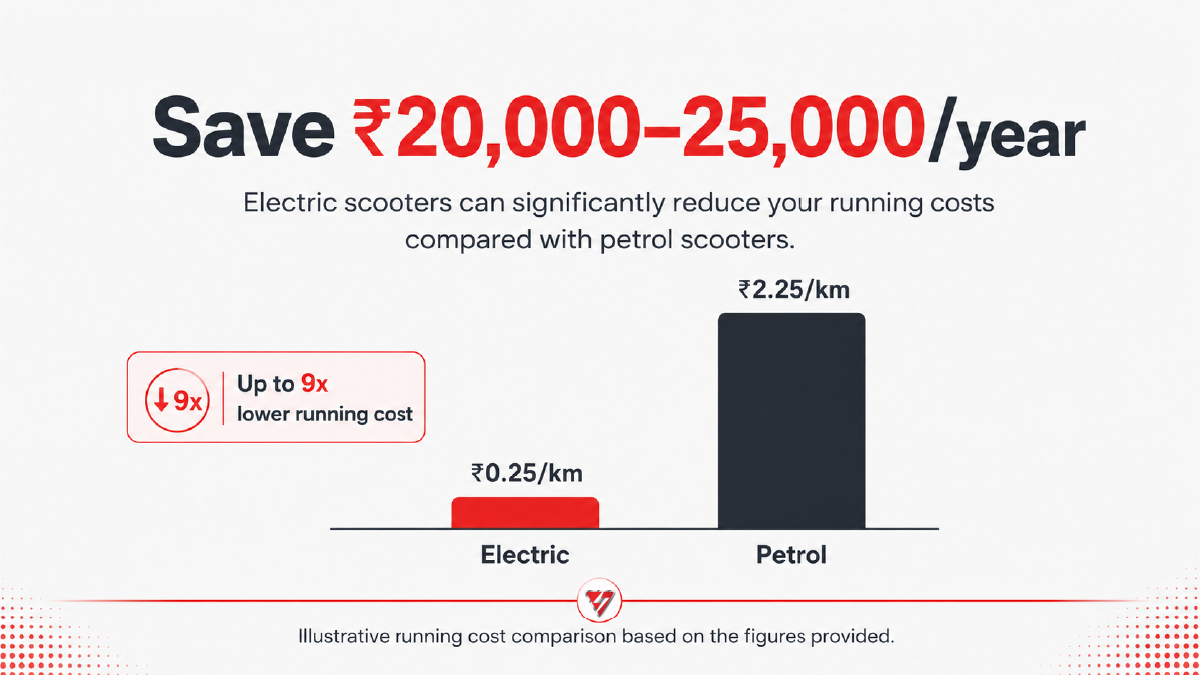
If you’re comparing an electric scooter vs petrol scooter in India in 2026, here’s the number that matters most: ₹0.25 per kilometre versus ₹2.25 per kilometre. That’s roughly a 10x difference in what it costs to ride every day. On a 30 km daily commute — about average for someone travelling between Dwarka and Connaught Place in Delhi, or Whitefield to MG Road in Bangalore — that gap adds up to ₹20,000 to ₹25,000 in savings per year. Just on fuel.
But fuel is only the start. Once you factor in maintenance, government subsidies, and registration costs, the picture shifts further. This isn’t a sales pitch — it’s a comparison using actual 2026 numbers so you can decide what makes sense for your commute. Quick primer for the unfamiliar: an electric scooter runs on a rechargeable lithium-ion battery you plug into a home socket overnight. No petrol, no engine oil, no exhaust.
Running Cost: What You Actually Pay Per Km
An electric scooter in India costs ₹0.20 to ₹0.30 per kilometre to run. A petrol scooter, at current fuel prices, costs ₹2.00 to ₹2.50. If you commute 30 km daily, your annual fuel bill on petrol is ₹22,000 to ₹27,000. On electric: ₹2,000 to ₹3,300. That’s a saving of ₹20,000 to ₹25,000 every year on running cost alone.
To put it practically: what you save on fuel in one year covers roughly six months of a broadband connection or a return train fare from Delhi to Goa for two. The electric scooter running cost per km in India is where the maths stops being theoretical and starts being felt.
5-Year Cost of Ownership — The Full Picture
Over five years, a 30 km daily commuter saves ₹1,00,000 to ₹1,25,000 on fuel and ₹25,000 to ₹30,000 on maintenance — roughly ₹1,25,000 to ₹1,55,000 total. The upfront price of an electric scooter is ₹10,000 to ₹30,000 higher than a comparable petrol model, but that premium is recovered within 12 to 18 months. After that, every kilometre is pure savings.
Maintenance: What Breaks, What Doesn’t
An electric scooter has no engine oil, no spark plugs, no timing belt. The electric scooter maintenance cost in India is ₹1,500 to ₹3,000 per year — brakes, tyres, and a general check. A petrol scooter runs ₹8,000 to ₹12,000 annually once you account for oil changes, filters, clutch plates, and the belt replacement that inevitably shows up in year three. That’s a gap of ₹25,000 to ₹30,000 over five years, plus fewer hours sitting at the service centre.
Range and Charging — The Honest Truth
Electric scooter range in India in 2026 sits at 80 to 120 km per full charge in real city conditions — traffic, stops, starts. Highway range drops to 60 to 80 km at sustained higher speeds. The average urban commute in India is 20 to 35 km round trip. Delhi NCR commuters average 25–30 km daily, Bangalore riders roughly 20–28 km. That means one charge covers two to three days of normal use.
Electric scooter charging time in India: 4 to 6 hours on a standard 5-amp home socket, 1 to 2 hours on a fast charger. Most owners plug in before bed and wake up to full charge. The range anxiety you feel before buying disappears within the first week of owning one.
Government Subsidies in 2026 — How Much Can You Save Upfront?
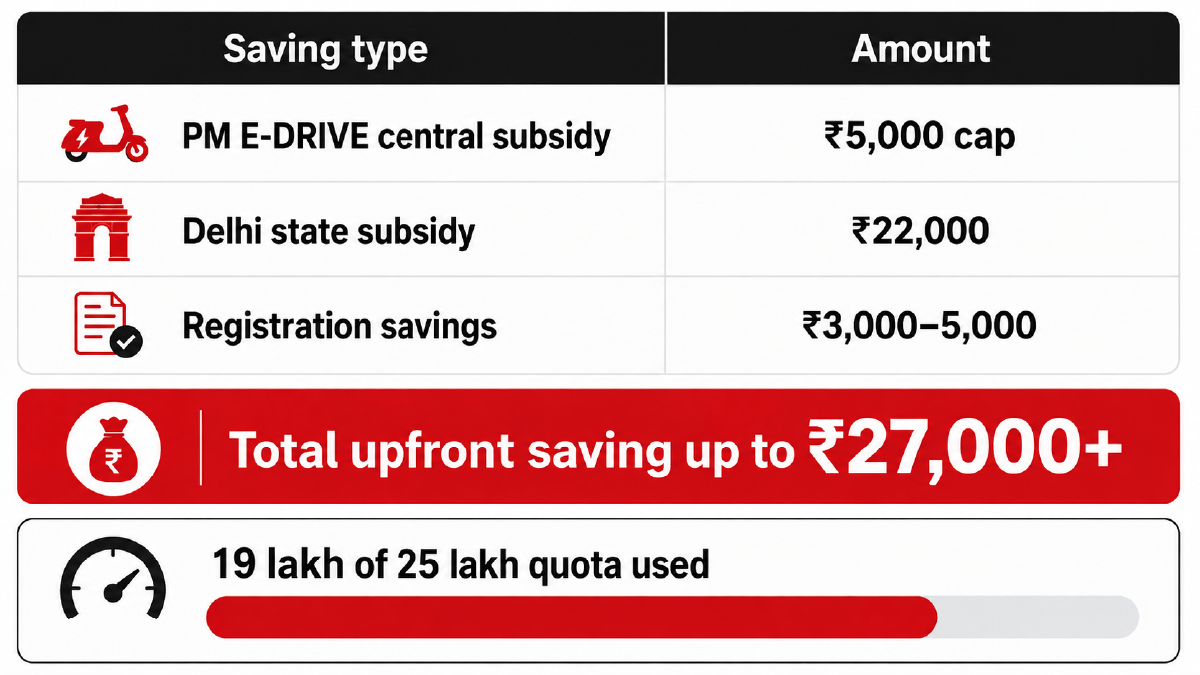
The FAME II subsidy ended in March 2024. The active scheme is PM E-DRIVE, running until July 31, 2026 for electric two-wheelers. Central subsidy: ₹2,500 per kWh of battery capacity, capped at ₹5,000 per vehicle. Most scooters with a 2 kWh battery get the full ₹5,000 off at purchase.
State subsidies stack on top. Delhi’s EV policy adds up to ₹22,000 — making the total upfront saving potentially ₹27,000. Maharashtra and Gujarat offer ₹5,000 to ₹10,000 extra. Registration costs are ₹3,000 to ₹5,000 lower for EVs across most states. Important: PM E-DRIVE is fund-limited. Over 19 lakh vehicles already sold against a 25 lakh quota. The window is genuinely closing.
Electric Scooters for Daily City Commuting in India
In Delhi NCR, the stop-start traffic actually favours electric — a petrol scooter idling in Outer Ring Road congestion burns fuel for nothing, while an electric draws zero power at a standstill. Combine that with Delhi’s additional ₹22,000 state subsidy and the case is hard to argue against.
In Bangalore, the tech corridor commute (Whitefield to Electronic City, Marathahalli to Koramangala) averages 15 to 25 km one way. An electric scooter handles the round trip on a single charge with range to spare. For both cities, the practical reality is identical: if your daily commute is under 40 km, an electric scooter for daily commute in India does everything a petrol scooter does, for a fraction of the cost.
Where Petrol Still Has the Edge
Highway trips beyond 80 km — petrol wins on convenience. Refuelling takes two minutes, not two hours. If you live in a rural area where charging infrastructure is thin, the flexibility of petrol is real. And for frequent intercity travel, petrol still gives you the range freedom that electric hasn’t fully matched. That said, these scenarios apply to a shrinking percentage of buyers.
Why e-Sprinto
e-Sprinto is present across the nation with an expanding dealership network, building electric scooters specifically for Indian road conditions. The lineup covers daily commuters to high-speed registered models, backed by an after-sales network that fleet owners — the toughest judges of vehicle reliability — already trust. Explore the e-Sprinto electric scooter range in India to find what fits your commute.
Verdict: Who Should Buy Electric — and Who Should Wait
If your daily commute is under 40 km, you have a regular power socket at home, and you live in or near an Indian city buy electric. The 5-year savings of ₹1.25 to ₹1.55 lakh are real. Is an electric scooter worth buying in India in 2026? For about 80% of urban commuters, yes — it’s the more rational financial decision.
Who should wait? Anyone whose primary use involves regular highway stretches above 80 km, or anyone in an area with inconsistent power supply and no reliable overnight charging. The infrastructure is catching up, but it’s not fully there for every use case. For everyone else, the numbers have already crossed the tipping point.
Frequently Asked Questions
What is the running cost of an electric scooter per km in India in 2026?
₹0.20 to ₹0.30 per km, compared to ₹2.00–₹2.50 for petrol. For a 30 km daily commuter, that’s ₹20,000–₹25,000 saved on fuel every year.
Is an electric scooter cheaper than petrol over 5 years in India?
Yes. A daily 30 km commuter saves roughly ₹1,00,000–₹1,25,000 on fuel and ₹25,000–₹30,000 on maintenance — totalling ₹1.25 to ₹1.55 lakh. The higher upfront cost is recovered within 12–18 months.
What is the real-world range of an electric scooter in Indian city conditions?
80–120 km per charge in city riding with traffic and stops. Highway range is lower at 60–80 km. A daily urban commute of 25–35 km means one charge lasts two to three days.
How long does it take to charge an electric scooter at home?
4–6 hours on a standard 5-amp socket for a full charge. Fast chargers do it in 1–2 hours. Cost per full charge: roughly ₹15–₹25 depending on your state electricity tariff.
What government subsidy is available on electric scooters in India in 2026?
PM E-DRIVE offers ₹2,500 per kWh, capped at ₹5,000 per vehicle. State subsidies add more — up to ₹22,000 in Delhi. Total upfront savings can reach ₹27,000–₹32,000 depending on your state.
What is the maintenance cost of an electric scooter vs petrol per year?
Electric: ₹1,500–₹3,000 per year. Petrol: ₹8,000–₹12,000. That’s ₹25,000–₹30,000 saved over five years on maintenance alone.
Is an electric scooter good for daily commuting in Indian cities?
For commutes under 40 km — which covers the vast majority of urban Indian riders — yes. A single charge handles 2–3 days of normal city commuting in cities like Delhi and Bangalore.
What are the disadvantages of electric scooters in India?
Three real ones: limited highway range (60–80 km), longer refuelling time (4–6 hours vs 2 minutes for petrol), and thinner charging infrastructure in rural areas. For daily city use, rarely dealbreakers.
Which is better for highway riding — electric or petrol scooter?
Petrol. Range drops to 60–80 km at highway speeds, and charging stations on highways are still inconsistent. For regular intercity travel above 80 km, petrol remains more practical.
Is it worth buying an electric scooter in India in 2026?
For urban commuters under 40 km daily with home charging — yes. The 5-year saving of ₹1.25–₹1.55 lakh plus subsidies up to ₹27,000 make it the stronger financial choice. The subsidy pool is shrinking, so waiting costs money.