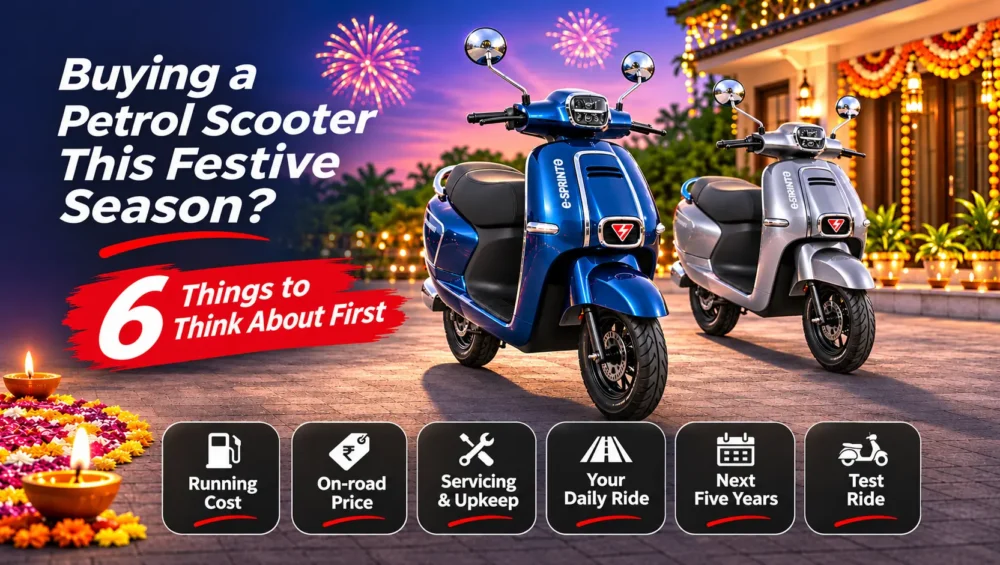
Festive season means scooter offers everywhere. Showrooms are packed, discounts are loud, and the pressure to decide quickly is real. But before you sign the papers, this petrol scooter buying guide covers six things worth checking – especially when scooter festive offers make every option look like a deal. Not to talk you out of it – but to make sure the scooter you bring home is actually the right fit for your daily life, your budget, and the next five years. Two minutes on each point now could save you real money later.
1. Work out the monthly running cost, not just the price tag
The sticker price isn’t what you’ll pay every month. Running cost is. This is where the petrol vs electric scooter running cost gap becomes impossible to ignore.
A petrol scooter averaging 45 km per litre at today’s petrol prices (roughly ₹105 per litre) costs about ₹1,750 per month if you ride 750 km. Add an oil change every 1,500-2,000 km and routine servicing, and you’re looking at ₹2,000-2,500 per month in fuel and maintenance.
An electric scooter covering the same 750 km costs ₹150-300 per month in electricity, charged at home on a regular socket. No engine oil. No oil filter. No air filter. Servicing is simpler and less frequent.
Monthly running cost comparison (750 km per month)
| Petrol scooter | Electric scooter | |
|---|---|---|
| Fuel / electricity | ~₹1,750 (at 45 km/l, ₹105/l) | ~₹150-300 (home charging at ₹7/kWh) |
| Servicing (monthly average) | ~₹300-500 | ~₹100-150 |
| Total monthly cost | ~₹2,050-2,250 | ~₹250-450 |
| Annual cost | ~₹24,600-27,000 | ~₹3,000-5,400 |
Assumptions: petrol at ₹105/litre, mileage at 45 km/l, electricity at ₹7/kWh, servicing averaged monthly. Your numbers will vary by city, riding style, and scooter model.
The difference is ₹20,000+ per year. Over five years, that’s ₹1 lakh or more – just on running cost.
Electric scooter check: Calculate your own monthly fuel spend. Then check what that same distance costs on a home-charged electric scooter. Let the numbers decide, not the discount.
2. Compare the on-road price, not the festive discount
Scooter festive offers grab attention. But the number that matters is the on-road price – what you actually pay to ride the scooter home.
On-road price = ex-showroom price + registration + road tax + insurance + handling charges. For petrol scooters, this typically adds 12-18% on top of the ex-showroom price. A scooter listed at ₹80,000 can cost ₹90,000-94,000 on-road.
For electric scooters, the on-road premium is often lower. Most states exempt EVs from road tax. Registration charges are either reduced or waived. And the PM E-DRIVE subsidy – currently extended to March 2028 – offers ₹2,500 per kWh of battery capacity, up to ₹5,000 per vehicle, for eligible electric two-wheelers priced under ₹1.5 lakh ex-factory.
Before you compare prices, ask the dealer for a written on-road quotation. Not a verbal estimate. A printed, itemised breakdown. Then do the same at an electric scooter showroom. Compare the two documents side by side.
Electric scooter check: Ask for the on-road price after state EV incentives and PM E-DRIVE subsidy. The gap between petrol and electric is often smaller than the ex-showroom numbers suggest.
3. Check servicing and spare parts in your town
A scooter is only as good as the service support behind it. This matters even more in Tier 2 and Tier 3 cities where authorised service centres can be limited.
For a petrol scooter, you already know the drill – engine oil changes every 1,500-2,000 km, air filter checks, spark plug replacements, valve adjustments. Spare parts are widely available, mechanics are everywhere, and the service ecosystem is mature.
For an electric scooter, the maintenance list is shorter. No engine oil. No air filter. No spark plug. No clutch. Routine servicing typically covers brakes, tyres, suspension, and battery health checks. But – and this is important – check whether the brand has an authorised service point near you. Ask if spare parts are stocked locally or ordered from a central warehouse. A two-week wait for a brake pad is not acceptable.
Electric scooter check: Before buying any electric scooter, confirm there’s an authorised service centre within 15 km. Ask about spare parts availability and average service turnaround time.
4. Match the scooter to your daily ride
Write down your actual daily commute. Not the weekend trip. Not the once-a-month highway run. Your Monday-to-Friday routine.
If your daily round trip is 20-30 km, a petrol scooter will handle it without a thought. But so will most electric scooters with 80-100 km of real-world range – and you’d charge once every 3-4 days instead of visiting the pump twice a week.
If your commute is 50 km+ daily or involves regular highway stretches at 60-70 km/h, a petrol scooter gives you flexibility. Electric scooters in this range exist, but check whether the real-world range (not the claimed range) comfortably covers your distance with buffer.
Also consider: do you have a home charging option? A ground-floor socket, a power point near your parking? If yes, electric works. If you’re in a fifth-floor apartment with no socket access, check whether the scooter has a removable battery you can carry upstairs.
Electric scooter check: If your daily commute is under 40 km and you can charge at home, an electric scooter covers your needs and costs a fraction of petrol.
5. Think about resale value and the next five years
Petrol scooters have a well-established resale market. A well-maintained Honda or TVS holds decent value after 4-5 years. This is a real advantage.
Electric scooter resale is still developing. The market is young, valuations aren’t standardised, and battery health concerns make buyers cautious in the used market. That said, the total cost of ownership over five years – purchase price minus running cost savings – often favours electric even if the resale value is lower.
There’s also the policy direction to consider. The PM E-DRIVE subsidy has been extended to March 2028. Multiple cities are tightening emission norms. Delhi has proposed restrictions on new petrol two-wheeler registrations from 2028. The direction is clear even if the timeline shifts. A petrol scooter bought today will still run for years. But an electric scooter bought today is more aligned with where things are headed.
Electric scooter check: Factor in five years of fuel savings against the resale difference. For most daily commuters, the electric scooter costs less to own over the full period.
6. Test ride before you decide
Don’t buy any scooter – petrol or electric – without riding it first.
On a petrol scooter, pay attention to engine vibration at idle and at speed, clutch feel (if it has one), braking confidence in traffic, and seat comfort for both rider and pillion.
On an electric scooter, notice the silence. Notice the instant torque from standstill. Check how the brakes feel without engine braking to assist. Sit with a pillion and check whether the motor handles the extra weight on an incline. Check the display – is it readable in sunlight?
Test both types back to back if you can. The difference in ride experience often settles the debate faster than any spec sheet.
Electric scooter check: Visit an electric scooter showroom in your city and take a test ride. The riding experience is the one thing no blog can describe for you.
Petrol or electric: which fits your ride?
Both have their place. If you do long highway stretches regularly, need maximum resale certainty, and don’t have home charging access, a petrol scooter still makes sense. If your commute is under 40 km daily, you can charge at home, and you want to spend less every month, an electric scooter is the smarter buy.
e-SPRINTO recently launched the G1, its first electric scooter designed specifically for Indian families. It’s worth a look if you’re exploring the electric side.
Things to check before buying a scooter – quick recap
- Monthly running cost calculated – not just the price tag.
- On-road quotation in writing – not a verbal estimate.
- Service centre confirmed near your home – with spare parts stocked.
- Daily commute matched – real-world range covers it with buffer.
- Five-year cost worked out – including fuel savings.
- Test ride done – both petrol and electric.
Frequently Asked Questions
Is the festive season a good time to buy a scooter?
Festive discounts are real, but they’re on the ex-showroom price, not the on-road price. Insurance, registration, and accessories often offset the headline discount. Compare the total on-road cost – not just the banner offer. If the deal is genuinely better than last month’s on-road price, it’s a good time. If only the sticker changed, it’s marketing.
Is an electric scooter cheaper to run than a petrol scooter?
Yes, significantly. Charging an electric scooter at home costs roughly ₹150-300 per month for 750 km of riding, compared to ₹1,750+ for a petrol scooter covering the same distance. Electric scooters also skip oil changes, air filter replacements, and most engine-related servicing. Over a year, the running cost difference is ₹20,000 or more.
How do I charge an electric scooter at home in a small town, and what about power cuts?
Most electric scooters charge on a standard 5-amp home socket – the same one your phone charger uses. You don’t need any special equipment. Charge overnight and you’re set for days. As for power cuts, they only affect charging time, not the battery itself. If your area gets 4-5 hours of continuous power overnight, that’s enough for a full charge on most models.
What about servicing and spare parts in a Tier 2 or Tier 3 city?
This varies by brand. Before buying, check whether the brand has an authorised service centre in your city – not just a dealer, but a service point with trained technicians and stocked spare parts. Ask about service turnaround time and warranty claim process. A brand with 100+ service points across 18+ states is a safer bet than one with a handful in metro cities only.
How does resale value compare between electric and petrol scooters?
Petrol scooters currently have a more established resale market. But electric scooter ownership savings over 5 years – ₹1 lakh+ in fuel alone – often make up for the lower resale. The used EV market is growing and will mature as more electric scooters enter their 3-5 year ownership window.